

Stephen Miller's Glass Ceiling
And why hating the right wing is a huge mistake


Stephen Miller serves as US Homeland Security Advisor, wielding tremendous influence in the Trump administration. I’ve paid closer attention since ICE operations hit close to home in Minnesota.
This quote from Stephen makes me wince:
“We live in a world in which you can talk all you want about international niceties and everything else, but we live in a world—in the real world, Jake—that is governed by strength, that is governed by force, that is governed by power. These are the iron laws of the world that have existed since the beginning of time.”
(January 5, 2026, on CNN’s The Lead with Jake Tapper)
Looking Deeply at What Is Hidden
I disagree with Stephen’s analysis of power.
More interesting to me, though, is seeing the internal glass ceiling beneath Stephen’s confidence. Like most leaders, he carries blocks to personal agency that limit his potential.
I don’t write this to belittle Stephen Miller. Self-limiting patterns are common in all of us. I would like to shine a light on them. Transcending these patterns allows us to live more fulfilled lives.
I also believe it is key to repairing the ideological divide ripping our country apart.
Don’t nurture hate
I want to put Stephen on the backburner for a moment before continuing this article. I have to get something off my chest.
Along with Stephen’s worldview, I wince at the hateful reactivity I see in fellow progressives.
The events in Minnesota this year have been horrific, and the community responses have been truly inspiring. It’s the first time the Trump administration’s authoritarian behaviors have been effectively rebuked. That gives me tremendous hope.
But it is disheartening to see progressives vilify the right wing.
Don’t get me wrong, I despise right wing beliefs. But treating these “enemies” as lesser humans nurtures poisoned seeds inside the hater. It cultivates a way of thinking, and an overall political dynamic, that can only lead to entrenched, generations-long conflict. Love will never win.
On top of that good reason, I see two major, practical benefits to honoring the humanity of people you otherwise want to hate:
Being the adults in the room. If you think about it, most political and social media discourse is not far removed from adolescent name calling. The words are bigger, the ideas more complex, and the consequences greater. But the psychological development on display is pretty much the same. As people promoting values like love, justice, and the common good, it is our responsibility to show that psycho-emotional maturity does in fact happen in the United States, and that we are the adults in the room.
Better ideas. In my work with clients, I constantly see how a reactive state of mind blocks forward movement. It doesn’t matter the type of issue they are facing or the scale. When they are angry, anxious, and otherwise antagonized, they react in one-dimensional, unproductive ways. As soon as they regulate and look at their situation with a broader lens, they see more, better options. Next steps are clearer and less daunting. This is not because they’ve experienced a breakthrough in strategic analysis. It’s about learning to nurture their nervous systems.
And let’s face it, this is basic Jesus stuff. “Love your enemies.” “Forgive them Father, they know now what they do.” Etc.
I’m not treading new ethical territory here.
One last things before returning to Stephen’s glass ceiling. Please don’t confuse what I’m saying with not holding people accountable for evil, unjust actions. I hope every person who breaks the law experiences privilege-dissolving, consciousness-changing consequences for their actions. Between January 6 rioters being pardoned and the Epstein files, I feel sickened by the lack of accountability in our country.
But if we can’t respect the basic humanity of people making historically disastrous choices, we have internalized the same violent patriarchal habits of mind that drive their power. We are not being the change we want to see in the world.
That’s not good.
Observable Cues in Interviews
Phew. OK, I feel better.
Now back to Stephen Miller. We can assume he operates at a high intensity in an extremely demanding job. Let’s imagine a plausible snapshot of Stephen’s inner experience based on observable cues.
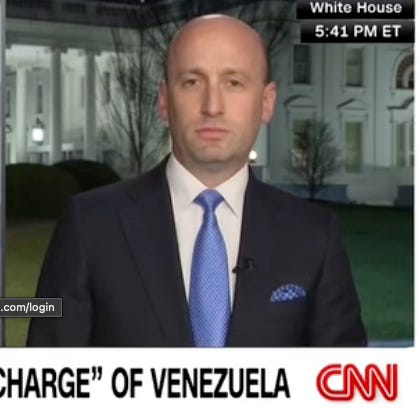
Watching the clip (here at 5:45), Stephen conveys certainty and authority. He seems matter-of-fact and comfortable in an energetic exchange with Jake Tapper.
He physically holds a restrained posture with minimal facial animation, even when delivering fiery talking points. He is focused, orderly, and unrelenting.
It’s impossible to ascertain another person’s emotions without them sharing. But Stephen’s physical cues suggest emotions like hyper vigilance, control, and being at-the-ready to engage. These are classic “fight” stress responses.
Emotions like elation, curiosity, and delight are not part of Stephen’s public persona. I hope they fill his personal life.
The observable physical cues and related emotions suggests the nature of Stephen’s thoughts. It’s easy to imagine he is often “in his head,” calculating with strategic insight, scanning situations for advantage, and wielding a critical internal narrative – toward both others and possibly himself.
This internal load bubbles into action. Colleagues call him “tenacious like a dog with a bone,” spamming the press with rants, and mastering combative messaging. Rally speeches vilify threats, whip up chants like “build the wall,” and escalate conflicts.
Stephen’s Baseline Pattern
Let’s consider all this as data that reveals a Baseline Pattern within Stephen:
Physical: Tight shoulders, fixed jaw, restrained posture
Emotional: Hypervigilance, controlled combativeness
Cognitive: Calculating, scanning for advantage
Behavioral: Aggressive rhetoric, tenacious execution
Consider these closely. Read them again. Based on this data, what might Stephen believe about himself?
To me, the data suggests that Stephen may not believe he is safe. Perhaps he is compelled to exert relentless effort to maintain security. Psychologists might call this a “fight-dominant baseline,” where safety is tied to control.
That’s my interpretation of Stephen’s pattern. What do you see?
The Cost of Fight-for-Control
It’s hard living with a Fight-for-Control Baseline Pattern, it is tiring and distressing. Fight-for-Control has been part of my own life. I prefer having set routines. They provide a sense of control, creating conditions where I can be creative and free.
For Stephen and myself, Fight-for-Control narrows emotional and operational range, leaving less room for nuance, adaptability, resilience, and connection with others.
Every problem can look like nail, and every solution a hammer.
Beyond Fight: Other Patterns
Fight-for-Control is one pattern linked to “fight” stress. Others include Rebel, Cynic, The Sarcastic One, and The Bulldozer. A “flight” stress response might look like Complainer, Overwhelmed, Martyr, or Whiner. When we “fawn” under stress, we can become The Flatterer, Peacemaker, Holy Protector, or Mr. Nice Guy.
We can develop particularly strong, rigid attachments to politically-oriented patterns (The Activist, The MAGA Patriot). When we do, we stop seeing the fullness of our own potential to understand others. We become enamored with a one-dimensional lens toward others. This keeps us from seeing the full range of possible responses to conflict.
That’s a huge loss. When we stop seeing that we have options, it leaves our country in an intractable impasse. There is no hope for “all of us.” The only possibility is some of us beating the others.
Unlocking Generative Patterns
Our Baseline Patterns tend to feel compulsive, in the sense that we don’t seem to choose them. Instead, it feels like “that’s just what happens to me when…”
This isn’t bad or an indication of failure. Baseline Patterns aren’t the end of the story. In fact, they point to how we can grow.
We can learn to transcend the habit of our Baseline Patterns and consciously choose other ways to respond. This builds self-agency, expanding choices and tools for living in our complex world.
Try the 5 Doorways Exercise
The key is to upcycle from our Baseline Pattern to a Generative Pattern that gives us more choices.
I developed a process called the 5 Doorways of Awareness to quickly inventory our Baseline Patterns through simple observation of internal cues:
Somatic
Emotional
Cognitive
Behavioral
Ontological (what we believe about ourselves).
Try out the 5 Doorways of Awareness with this guided meditation:
What Baseline Pattern shows up for you?
If you’re comfortable, reply below and I’ll be happy to help you unpack your results.
In any case, I’d love to hear your reflections on anything and everything.
Thank you.
Wow! The 5 doorways meditation is so helpful in revealing what is going on in me and how I’m in control of the change that needs to happen. Thank you!
Excellent